Project Description
Design and Sustainability Assessment of Innovative biomass production systems and value-chains in the Bioeconomy
DESTINY
Developing the bioeconomy features high on the European policy agenda to tackle societal challenges such as climate change, the phasing out of fossil resources or the advent of the much needed ecological and energy transitions. However, transitioning into an economy based on regionally available biological resources will substantially increase the demand for biomass from forestry and agriculture, and may incur adverse effects on biodiversity, greenhouse gas emissions or water resources. Comprehensive, rigorous and transparent assessment procedures are thus required to ensure that the bioeconomy will deliver on its sustainability promise.
Assessment methodologies have so far failed to embrace the various dimensions of sustainability and the multiple facets and stakeholders of bioeconomy systems. This lack of an integrated, holistic approach constitutes the key scientific question that DESTINY will address, by developing novel methods and tools as well as demonstrating how they can be mobilized to maximize systems performance in a range of generic value-chain cases-studies.
Since such concepts mobilize a number of disciplines from agronomy and engineering to economics, political and social sciences, a novel type of scientist is warranted: the bioeconomist. The DESTINY Doctoral Network will train this new generation of researchers and practitioners through a multi-disciplinary curriculum, equipping Doctoral Candidates with the knowledge they need to design and assess novel biomass production systems and bio-product value-chains. In their research programme at the crossroads between bioeconomy and sustainability science, these candidates will design sustainable bioeconomy systems for Europe, factoring in social, economic and governance aspects. DESTINY graduates will bridge a well-evidenced gap on the labour market for the bioeconomy, and will secure jobs in the agricultural and forestry sectors, the bioeconomy industry, academia, consultancies and governments.

Scientific Work Packages
WP3 Biomass Supply System Design
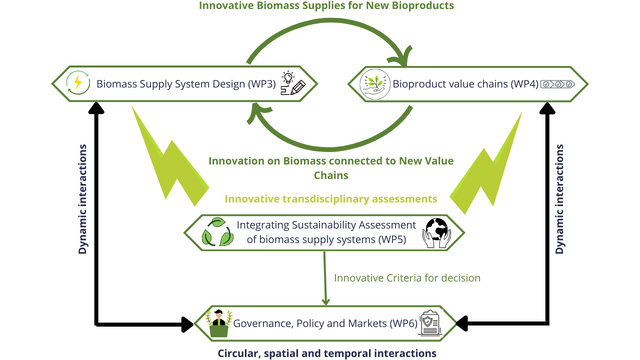
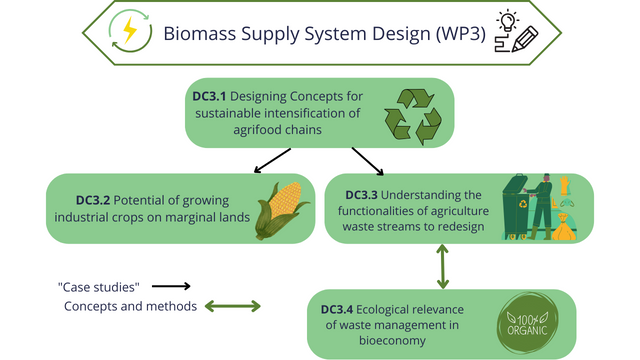
WP3 focuses on the design of biomass supply systems. Dealing with bioeconomy relies on the design of feedstocks and processes with improved quality for a Circular Bioeconomy. The ability of agriculture to produce biomass requires both the identification of new potential sources and relevant, resilient production systems. Therefore, WP3 will combine methodological approaches to embrace the complex issues of sustainable biomass production and quality of feedstocks and to question the consistency of recycling waste or valorising side streams. These two methodological approaches will be developed in connection with “case-studies” on the opportunity to produce biomass on marginal lands and to strengthen the role of agricultural wastes on new crop systems. WP3 will be connected to WP4 which deals with value-chains based on agricultural or forest biomass and to WP5 as a global assessment is required to obtain sustainable systems.
WP4 Bioproduct Value Chain
WP 4 on Bioproduct value chains aims to increase sustainable and economically feasible bioproduct valorisation in European agricultural and forestry sectors to increase industrial self-sufficiency and limit its dependency on petrochemicals. WP4 contributes to the DESTINY network by multidisciplinary themes in biomass conversion and product development with leading European partners. Themes address biomass fractions from new initiatives of agriculture (hemp) and forestry (wood and cellulose). Selected product-driven innovations in material, chemical and energy product sectors provide platforms to assess their valuable performance. It features novel means to develop the biomass value and drives the market uptake of these bio-based products. The studies also address the challenges on integrating these new biorefined products and processes to fit the well-established feedstock-specific industrial value-chains through an early stage evaluation of bio-based production chains, which will be complement on the assessment side by those from WP5 on material flows and WP6 on governance, policies and markets.

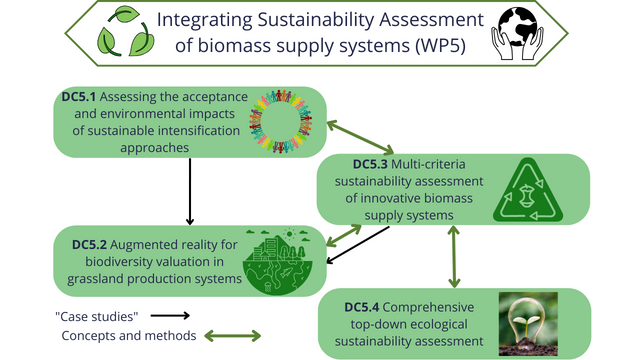
WP5 Integrating Sustainability Assessment of biomass supply systems
WP5 aims to advance and integrate the methodological tools for the sustainability assessment of biomass supply systems. Sustainable biomass supply is a key prerequisite for sustainable bio-based value chains as it can be dealt in WP3. WP5 puts an emphasize on the feedstock provision, to explore in depth the implications of innovative biomass supply systems. Therefore, 4 DCs advance the methodical foundation of sustainability assessment for biomass supply systems and apply them to approaches investigated in WP3. The four DCs in WP5 will work closely with their peers in WP3 and WP4 to gain a detailed understanding of innovative biomass supply systems in the context of novel bio-based value chains. Selected sustainability indicators will be provided to WP6 for the development of innovative policy instruments and governance.
WP6 Governance, Policy and Markets
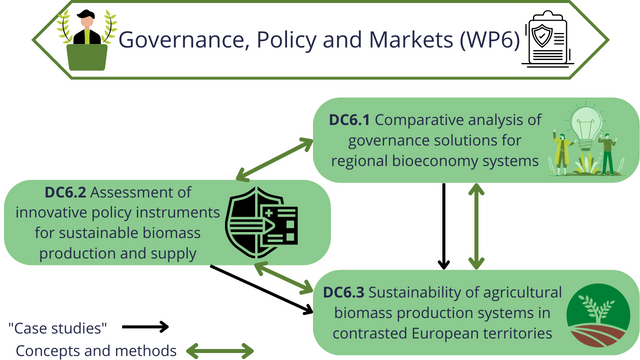
WP6 is focused on governance, policies and markets combining local and global scales. It takes on board three items which strongly constrain or drive the dynamics of biomass and bioproduct systems. First, governance schemes strongly impact the development of local or global value-chains, and private companies – including farmers – together with public authorities are prominent stakeholders in this process. Policies, which are the second driver, often reflect the balance between private ambitions and citizens’ powers. Governance and policies both need to be informed by more comprehensive assessments, which are addressed in WP5 and mobilised in WP6. Markets form the third focus of WP6, as their diversity or dynamics impact biomass production and bioproduct value chains.